In Malaysia, more than 70% of web traffic comes from mobile devices. Most of those devices are mid-range Android phones — Samsung A-series, Oppo, Vivo, Xiaomi Redmi — browsing on LTE (4G) connections, not fibre. A website that loads beautifully on a MacBook on office WiFi may take 8 seconds to load on a Redmi Note browsing on Unifi Air in Klang.
That 8-second load time is not just inconvenient. It is catastrophic for your business.
What Happens When Your Website Is Slow
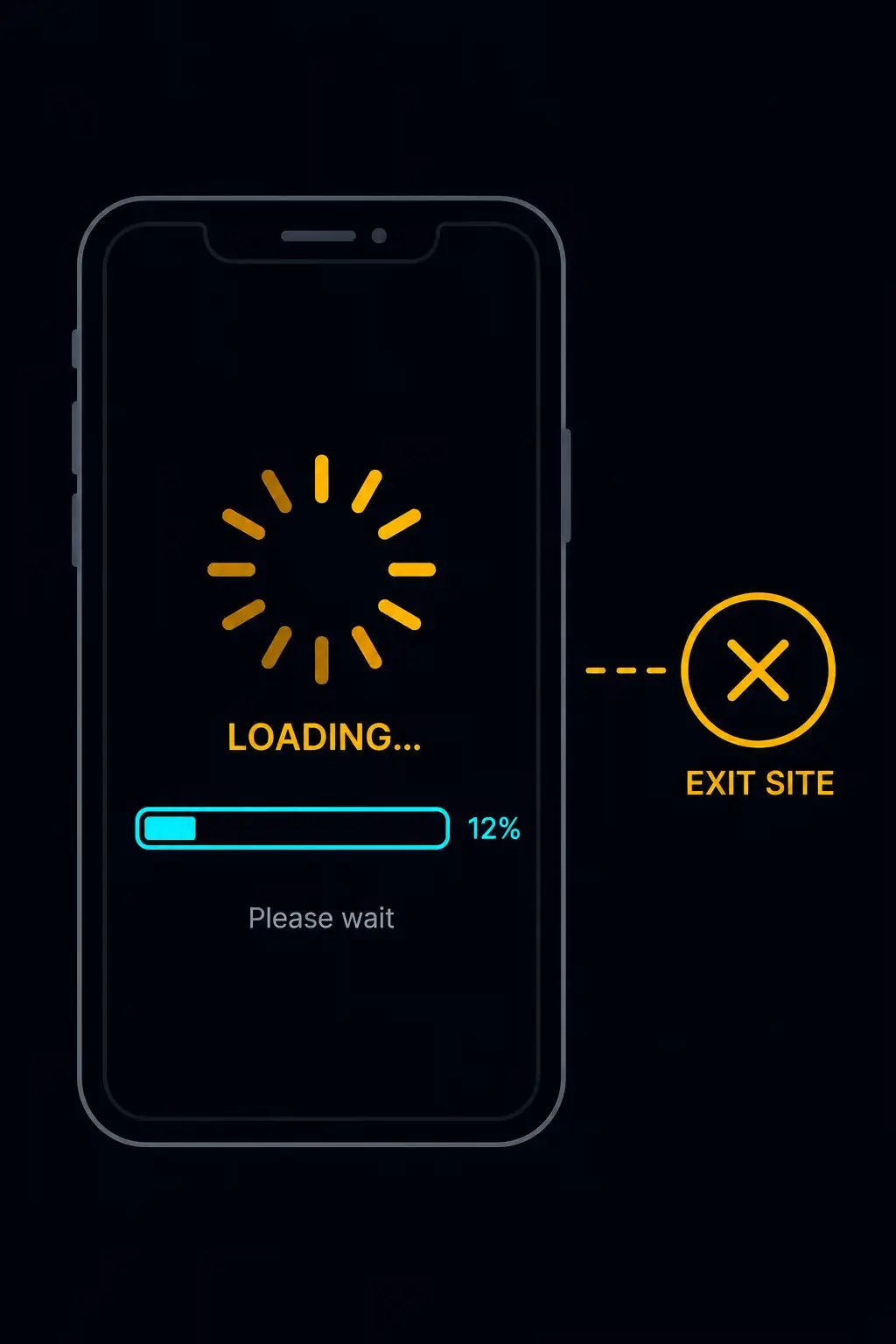
Google's research — widely cited in the industry — found that 53% of mobile visitors abandon a website if it takes longer than 3 seconds to load. That is not a marginal drop-off. More than half of your potential clients leave before they see your services, your photos, or your contact button.
For a Malaysian SME, the numbers compound quickly. If your site gets 500 visitors per month and loads in 6 seconds, you may be losing 250 to 300 of those visitors before they ever see anything. The site could be beautifully designed and completely useless simultaneously.
Slow load speed also hurts your Google ranking. Google's algorithm uses page speed as a ranking factor — especially for mobile searches. A slow site ranks lower than a fast one, all else being equal. So you are not just losing visitors who land on your site; you are losing visitors who would have found it in Google but did not because a faster competitor outranked you.
What "Load Speed" Actually Means
Load speed is how long it takes from the moment a visitor types your URL (or clicks your search result) to the moment they see the main content on the page.
There are two specific metrics worth knowing:
Largest Contentful Paint (LCP): The time until the largest visible element — usually a hero image or a headline — appears on screen. Google's recommended threshold is under 2.5 seconds for a good user experience.
First Contentful Paint (FCP): The time until any content appears at all. This is what prevents the dreaded "blank white screen" experience.
Both of these are measured under real-world conditions — mobile network speeds, average device processing power — not on your office fibre connection.
The Main Causes of Slow Websites
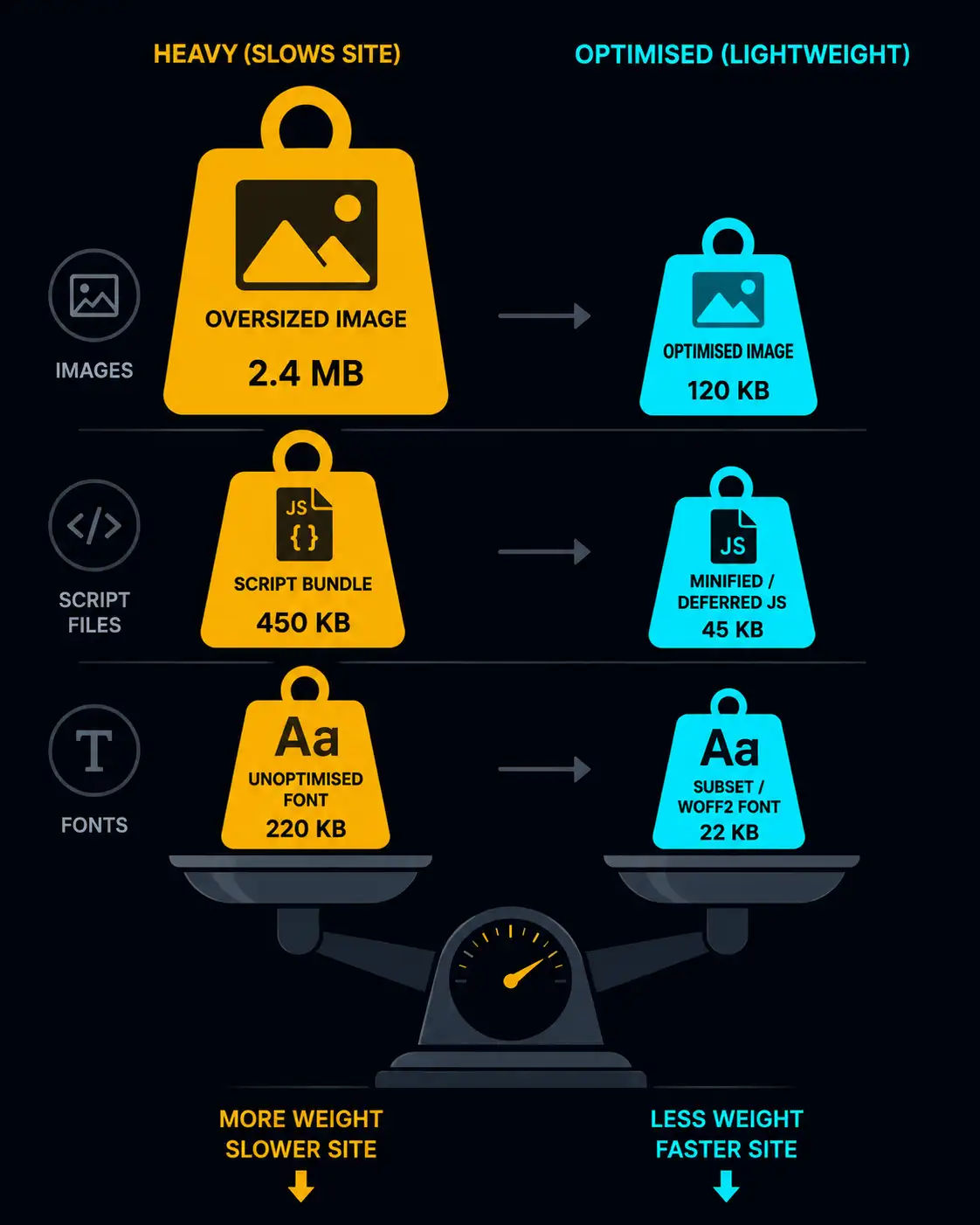
Oversized images. This is the most common cause of slow websites for Malaysian SMEs. A photo taken on a modern smartphone is typically 3 to 8 MB. A web page might have 8 to 10 of these. That is 30 to 80 MB of images loading sequentially. On a 4G connection, that is 10 to 30 seconds of load time — assuming the connection is stable.
The fix: compress all images to WebP format before uploading. WebP images are typically 60 to 80% smaller than JPEG equivalents at the same visual quality. A 4 MB photo becomes a 400 KB WebP file. The visual difference to the human eye is negligible. The load time difference is dramatic.
Unoptimised code. Websites built with heavy frameworks, multiple JavaScript libraries, or bloated CSS load slowly because the browser must download and process all of that code before displaying anything. Simpler code loads faster.
Slow hosting. Budget hosting providers store websites on overcrowded servers. When many sites share the same server and the server is under load, all sites slow down. The hosting tier matters.
No caching. Caching stores a version of your site so that returning visitors — or visitors in the same geographic area — receive content from a server closer to them, faster. Platforms like Vercel (which Paeveul uses) handle this automatically through a global content delivery network (CDN). Many cheap hosting providers do not.
Render-blocking resources. If a website loads fonts, scripts, or stylesheets in a way that pauses the rendering of the page, visitors see a blank screen while those files download. This is a technical issue that affects how the HTML is written.
How to Check Your Website's Speed
Two free tools give you an accurate picture:
Google PageSpeed Insights (pagespeed.web.dev): Enter your URL and Google will score your site from 0 to 100 for both mobile and desktop, with specific recommendations for what is slowing it down. A score above 70 on mobile is acceptable. Above 90 is excellent.
GTmetrix (gtmetrix.com): A more detailed analysis with waterfall charts showing exactly which resources are loading slowly and in what order. Useful if you want to understand the technical specifics.
If your current website scores below 60 on mobile in PageSpeed Insights, your load speed is actively costing you leads.
How Paeveul Builds for Speed
Every site Paeveul builds is optimised for Malaysian mobile networks from the start. Our technical choices are deliberate:
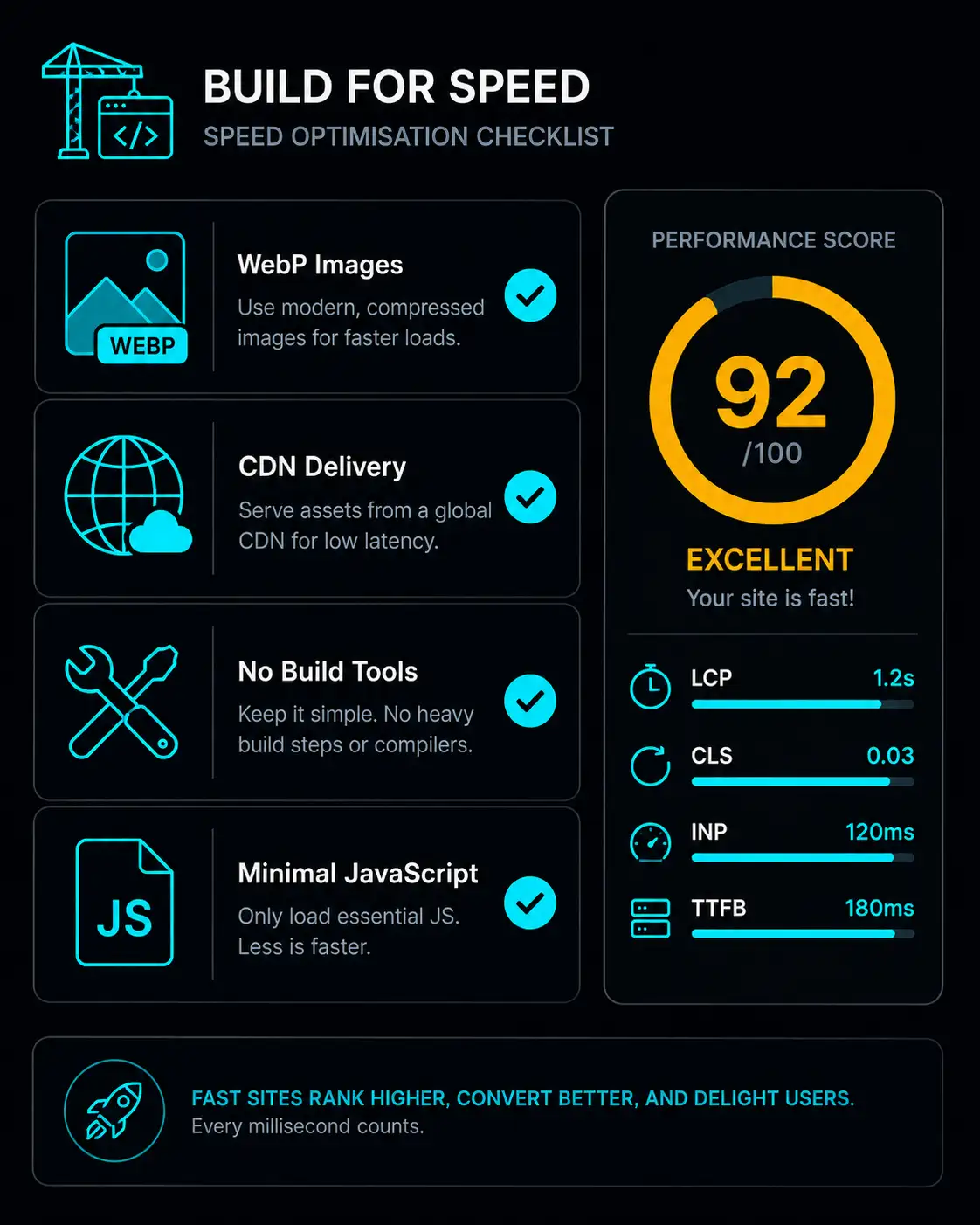
Single HTML file with Tailwind CSS via CDN. No build process, no bundling overhead. The site code is lean.
All images converted to WebP. We use Squoosh (a free browser tool) to convert and compress every image before it goes into the site. A typical 8-photo gallery page loads in under 2 seconds on LTE.
Hosted on Vercel. Vercel deploys sites globally on a CDN. Visitors in Petaling Jaya receive content from a server physically close to them, not from a server in Singapore or the US.
No unnecessary JavaScript. Where JavaScript is used (such as our gallery lightbox), it is written in vanilla JS — no heavy frameworks that inflate the file size.
The result is sites that consistently score 85 to 95 on Google PageSpeed Insights mobile — well above the average for Malaysian SME websites.
What You Can Do If Your Current Site Is Slow
If you have an existing website and suspect it is slow, start with PageSpeed Insights. Run the test and review the recommendations.
The two fastest wins are almost always:
- Compress your images. Download your current site's images, run them through Squoosh (squoosh.app — free, browser-based), and re-upload the WebP versions. This alone can cut load time by 50 to 70%.
- Ask your hosting provider about caching and CDN. If your host does not offer a CDN, consider migrating to one that does.
If your site was built on a heavy platform (certain WordPress themes, for example) and scores below 50 on mobile, it may be more practical to rebuild on a lighter architecture than to optimise an inherently slow foundation.