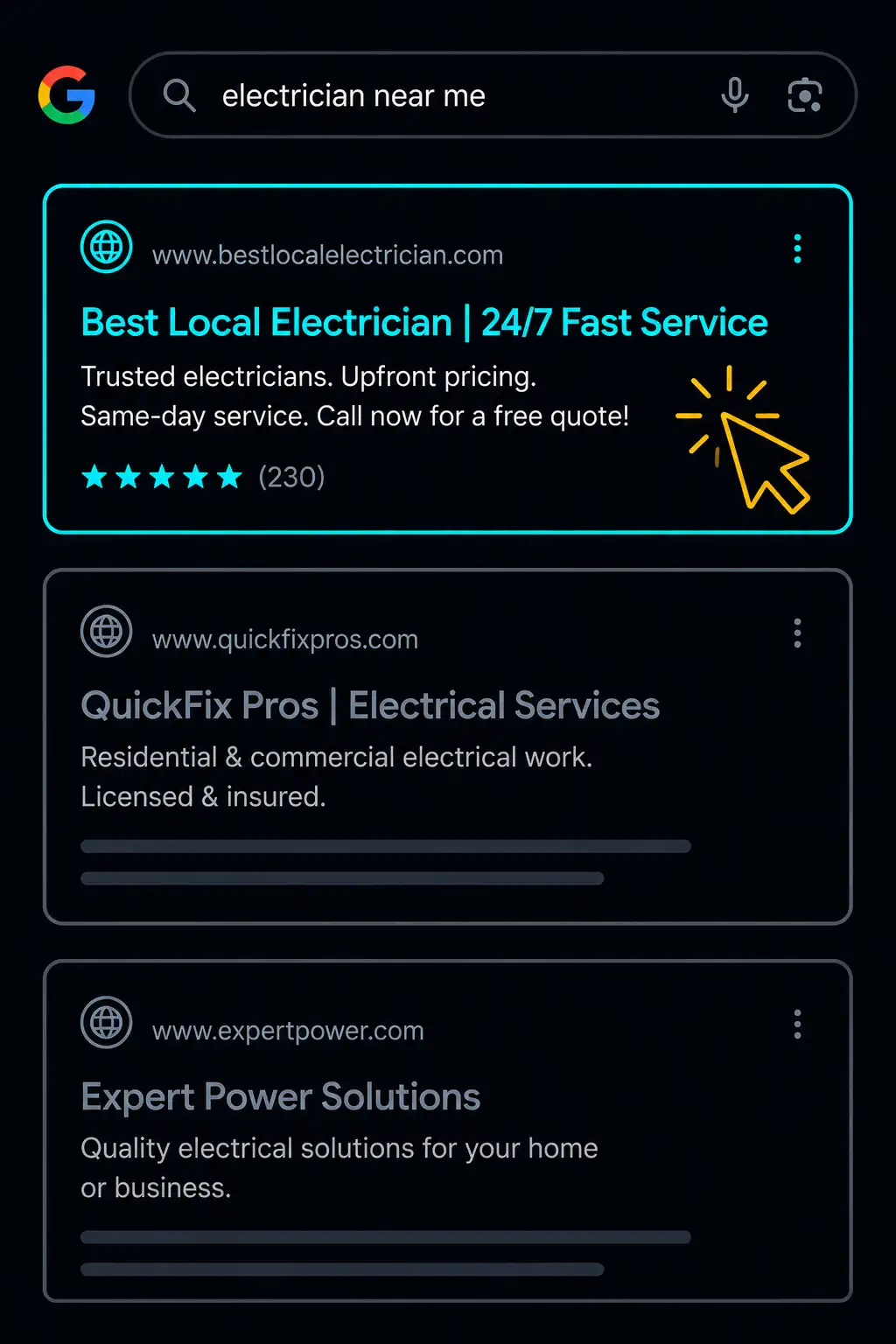
When your website appears in Google search results, two pieces of text show up beneath your URL. The bold, clickable line at the top is your meta title. The grey paragraph beneath it is your meta description.
Most business owners have never written these deliberately. They are auto-generated from whatever Google finds on the page — which is usually the first paragraph of text, the page title set during the website build, or a combination of both. The result is often confusing, cut-off, or simply irrelevant to what someone is searching for.
This matters because your meta title and description are the only parts of your website that most people will see before deciding whether to click. If they are poorly written, you lose the click to a competitor whose snippet looks clearer and more relevant — even if your actual site is better.

What a Meta Title Is
The meta title (also called the page title or title tag) is the bold, clickable text that appears as the headline of your listing in Google search results. It also appears in the browser tab when someone has your site open.
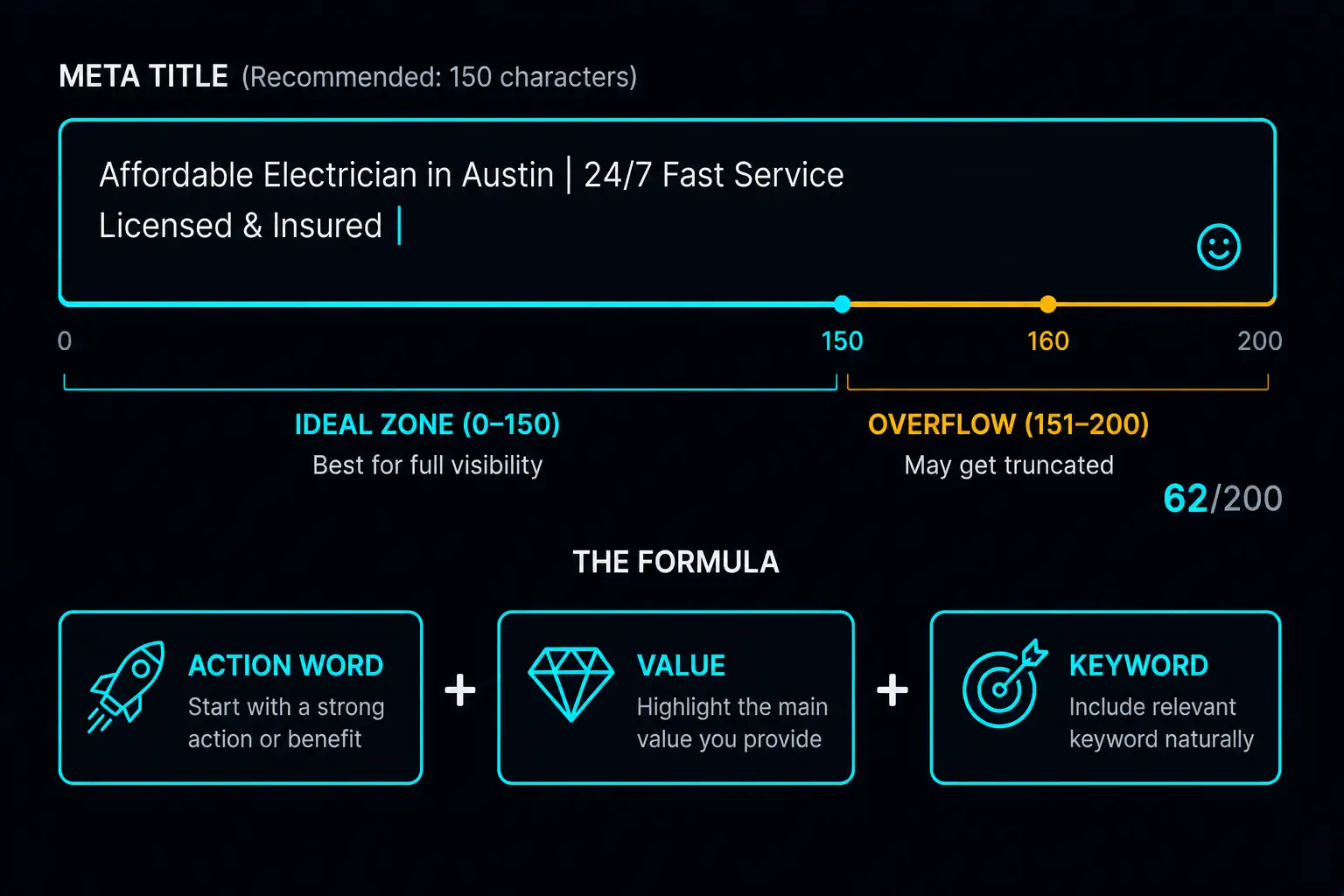
Google typically displays 50 to 60 characters of a meta title before cutting it off. If your title is longer than that, it appears truncated with an ellipsis.
Example of a weak meta title:
Home | Ahmad Hardware Enterprise
This tells a searcher almost nothing. They already know they are looking at a hardware business. They do not know what you stock, where you are, or why they should click you instead of the next result.
Example of a strong meta title:
Hardware Supply for Contractors — Shah Alam | Ahmad Hardware
This tells the searcher: what you supply, who you serve, and where you are. Three pieces of useful information in under 60 characters.
What a Meta Description Is
The meta description is the 2 to 3 line text paragraph that appears beneath the meta title in search results. Google displays up to approximately 155 characters before cutting off.
The meta description does not directly affect your search ranking — Google has confirmed this. But it directly affects your click-through rate (CTR), which is the percentage of people who see your listing and click it.
A meta description with a clear value proposition and a direct call to action consistently outperforms a vague or auto-generated one.
Example of a weak meta description:
Ahmad Hardware Enterprise has been serving the hardware needs of customers in the Klang Valley area since the year of its establishment.
This is 130 characters of almost no useful information. No specific products, no location clarity, no reason to click.
Example of a strong meta description:
Pipes, fittings, tools, and electrical supplies for contractors in Shah Alam. Open 7 days. Call or WhatsApp for bulk order pricing.
Specific products, clear location, operating hours, and a direct invitation to act. 130 characters.
Why This Matters More Than You Think
Consider what happens in a Google search results page. A user sees 5 to 10 listings. They scan the meta titles first — looking for the one most relevant to their search. Then they read the meta description of the ones that look promising.
Your meta title and description is your advertisement in Google search. You are not paying per click (this is organic search, not paid ads), but the competition for attention is just as real.
A competitor with a clear, well-written snippet will consistently capture clicks that a vague, auto-generated one misses — even if both sites rank in similar positions.
We have seen well-optimised meta titles and descriptions increase click-through rates by 20 to 40% for the same ranking position. That means 20 to 40% more visitors without any change in ranking.
How to Write a Meta Title
Follow this format for most Malaysian SME pages:
[Primary service or keyword] — [Location] | [Business name]
Or for a homepage specifically:
[What you do] for [who] in [location] | [Business name]
Examples:
Aircond Installation and Service — Klang Valley | Alphamatic AirconditioningWebsite Design for Malaysian SMEs — From RM 1,300 | Paeveul Web ServicesMalay Wedding Catering Selangor — RM 8/pax and Above | Mak Cik Noor Catering
Rules:
- Keep it under 60 characters (count carefully — every character counts)
- Include your primary keyword near the front
- Include your location for local businesses
- Include your business name at the end (for brand recognition in repeat searches)
How to Write a Meta Description
Your meta description should do three things in 155 characters:
- Confirm what you offer (so the searcher knows they are in the right place)
- Add one specific detail that builds credibility or differentiation
- End with a direct action
Template:
[Specific service] for [target client] in [location]. [One credibility detail]. [Call to action].
Example for an HVAC company:
Aircond installation, servicing, and repair for homes and offices in Klang Valley. Certified technicians. WhatsApp for a same-day quote.
That is 136 characters. Specific, credible, actionable.
Where to Set Meta Titles and Descriptions
This depends on how your website was built.
WordPress: Use a plugin like Yoast SEO or RankMath. Both have a field for meta title and description on every page.
Wix or Squarespace: Both platforms have a built-in SEO settings panel for each page where you can set the title and description manually.
Custom HTML/CSS site (like those built by Paeveul): Your web designer sets these in the <head> section of each HTML file. When you brief your designer, provide the exact text you want for the meta title and description — do not leave it to be auto-generated. At Paeveul, we set these for every page we build.
One More Thing: Google Sometimes Rewrites Your Snippet
Google reserves the right to display a different title or description than what you have set — especially if their algorithm determines that your version does not match the searcher's query well enough. This happens more often with descriptions than titles.
You cannot prevent this entirely. But well-written, on-point meta content is rewritten by Google far less often than vague or keyword-stuffed content.
Write for the human reader first. Google's rewriting algorithm tends to replace copy that reads like it was written for a robot.